Sunscreen use is increasing, but skin cancer rates are also rising. Does that mean sunscreen doesn’t work, or – even worse – sunscreen might cause skin cancer? This was one of the common sunscreen myths I debunked in this video.
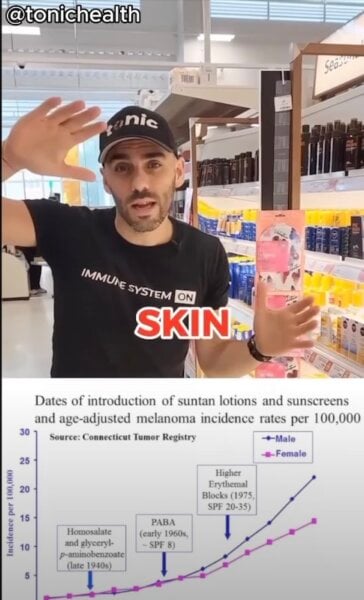
Here’s one example, from @TonicHealth on TikTok:
“Why is nobody talking about this?
All these sunscreens are not doing the job they’re designed to do. They’re meant to protect you from the sun, right? But why then does this chart show that since 1975, the increasing skin cancer rate is going up and up and up? The more sunscreen we use.
Makes no sense, right? It’s not having good health outcomes for our populations.”
This might seem reasonable at first glance, but let’s take a closer look…
Correlation isn’t causation
First off, correlation isn’t causation. But this graph doesn’t even show a correlation – there’s no line for sunscreen here, just a general trend of increasing melanoma incidence in the US since the 1930s.
Related Post: US Sunscreens Aren’t Safe in the EU? The Science
A lot of other things have also increased since the 1930s. We could use the same logic to say skin cancer is caused by:
- eating more chocolate
- using more electricity
- more car sales
- more TikToks about sunscreen being dangerous
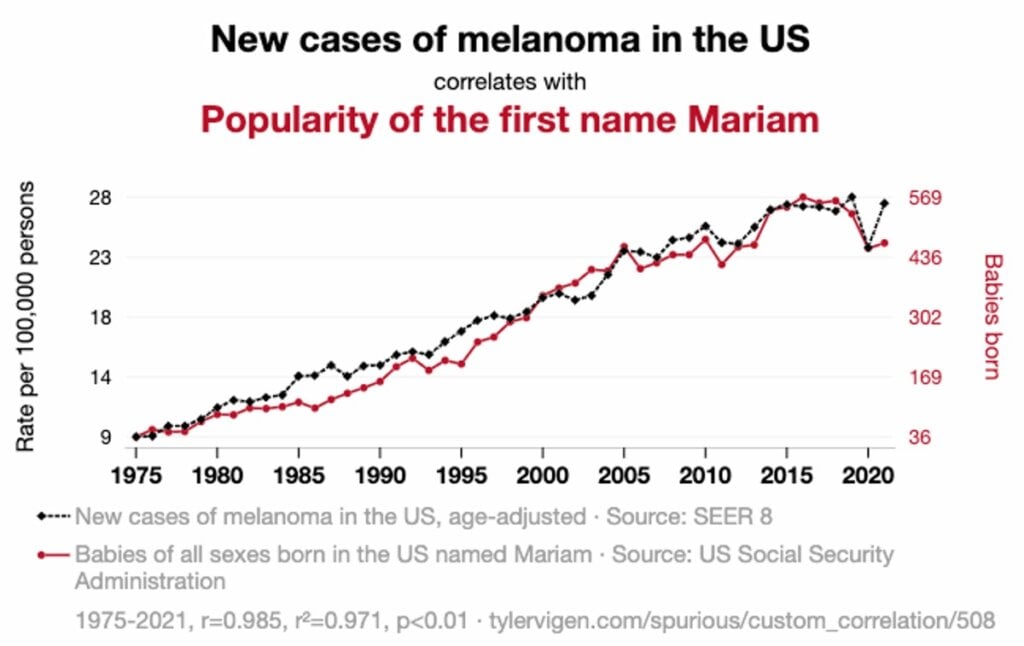
You can upload data to find more correlations on Spurious Correlations – turns out US melanoma rates correlate really well with babies called Mariam.
Related Post: Sunscreen absorption and receptor binding: Debunking TikTok Misinformation
How do we know sunscreen isn’t increasing skin cancer?
While sunscreen was introduced in the 1940s, its use only became widespread in the 1970s, so you can see from his graph that the rise in skin cancer is actually an existing trend continuing.
But the big problem with real-life trends is that there’s a ton of other variables that aren’t controlled, that could be explaining the increase.
Experiments called randomised controlled trials (RCTs) get rid of these other factors. This is where two roughly equal groups do 2 different things, and the outcomes are tracked.
The largest and most famous RCT on sunscreen was the Nambour Trial. People in the same location, of similar ages, with matched skin colour were split into two groups – the only difference was sunscreen use. Half the people wore sunscreen every day consistently (daily sunscreen), while the other half only wore sunscreen when they wanted to (discretionary sunscreen) for 4.5 years, then the researchers followed what happened to them for the next 10 years as well.
If sunscreen caused skin cancer, you’d see more skin cancers in the daily sunscreen group. This didn’t happen! Instead, they found that for the daily sunscreen group:
- 40% reduced squamous cell carcinomas during the trial (4.5 years)
- New SCCs and SCC incidence around one-third lower 8 years later
- 24% reduction of actinic keratoses in first 2 years
- Invasive melanoma reduced by 73% after 15 years
- Average invasive melanoma thickness was reduced (0.53 mm vs 1.2 mm)
Daily sunscreen users also had 24% less signs of aging!
Another type of study: different amounts of sunscreen were applied to skin, before blasting it with a lamp that produces similar UV to the sun. Then they looked for pyrimidine dimers in DNA – these are mutations caused by UV, that are the first step towards skin cancer. They found that with more sunscreen, there were less messed up DNA.
Why is skin cancer increasing?
So why are skin cancer rates increasing everywhere else?
Basically, there are other things pushing the cancer rate up, and it’s overwhelming how much sunscreen use can push the rate down. The main explanations (some are here):
Living longer: More time means cells have more opportunity to mutate. On average, people get diagnosed with melanoma at age 65 – people used to die of other things before they were counted as a skin cancer case.
Different patterns of sun exposure: Cheaper flights means people are going on beach holidays far more, so many people are exposing their skin to more sun, including many indoor workers who are exposing their normally sun-protected skin to very intense sun for a few weeks each year. It’s also a lot easier now to go to the beach.
Tanning: There is also a greater desire to tan – the US FDA started regulating sunscreen around the same time as UV tanning beds appeared.
Increased screening and detection: Greater awareness of skin cancers (e.g. ABCDE’s of questionable spots) means people and doctors are finding more of them.
Related Post: DIY sunscreen test? Reacting to Style Theorists’ video
Skin cancer isn’t increasing everywhere
Importantly, the overall increase in skin cancer isn’t happening everywhere.
Melanoma in people under 40 has actually decreased in Australia, the country with perhaps the strongest sunscreen culture! In Australians aged 15 to 24, melanoma rates have roughly halved since the 1980s. This is thought to be the combined impact of increasing population diversity and SunSmart initiatives.
Australia’s SunSmart approach
The biggest reason for Australia’s unusual trend seems to be our far more coordinated public health approach to sun protection, compared to other countries. Importantly, SunSmart initiatives aren’t just about wearing more sunscreen.
Related Post: Should you avoid retinyl palmitate in sunscreens?
Simply knowing that sunscreen reduces skin cancer doesn’t make people use it, or apply it properly. Behaviour is largely guided by values and convenience and habit.
In Australia, sun education has been very pervasive:
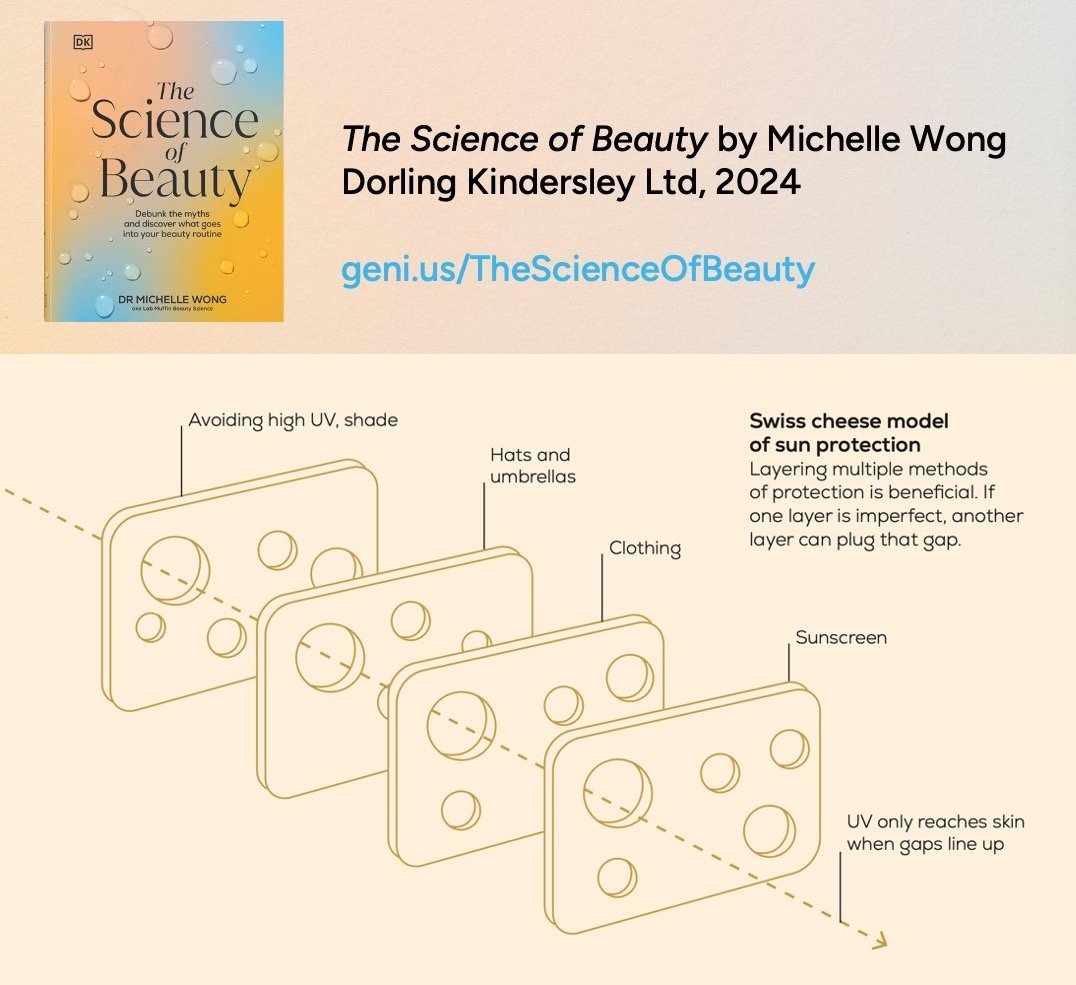
“Slip Slop Slap Seek Slide” is a popular slogan – it stands for “Slip on a shirt, slop on sunscreen, slap on a hat, seek shade, slide on sunglasses”. This emphasises that you should be layering your sun protection, rather than relying on error-prone sunscreen alone (the Swiss cheese model of sun protection)
“No hat, no play” – this is a common school policy. If you didn’t bring your hat to school, you had to sit on a bench and watch everyone else play at lunchtime. (Eventually it became “no hat, play in the shade” – possibly because teachers felt bad for the sad little kids.)
School hats – The legionnaire hat was the most popular type, with a long flap on the back for neck protection (teachers would tell you off if you tucked the flap up)
References
Green A, Williams G, Neale R, Hart V, Leslie D, Parsons P, Marks GC, Gaffney P, Battistutta D, Frost C, Lang C, Russell A. Daily sunscreen application and betacarotene supplementation in prevention of basal-cell and squamous-cell carcinomas of the skin: a randomised controlled trial. Lancet. 1999 Aug 28;354(9180):723-9. doi: 10.1016/S0140-6736(98)12168-2.
van der Pols JC, Williams GM, Pandeya N, Logan V, Green AC. Prolonged prevention of squamous cell carcinoma of the skin by regular sunscreen use. Cancer Epidemiol Biomarkers Prev. 2006 Dec;15(12):2546-8. doi: 10.1158/1055-9965.EPI-06-0352.
Green AC, Williams GM, Logan V, Strutton GM. Reduced melanoma after regular sunscreen use: randomized trial follow-up. J Clin Oncol. 2011 Jan 20;29(3):257-63. doi: 10.1200/JCO.2010.28.7078.
Darlington S, Williams G, Neale R, Frost C, Green A. A randomized controlled trial to assess sunscreen application and beta carotene supplementation in the prevention of solar keratoses. Arch Dermatol. 2003 Apr;139(4):451-5. doi: 10.1001/archderm.139.4.451.
Hughes MC, Williams GM, Baker P, Green AC. Sunscreen and prevention of skin aging: a randomized trial. Ann Intern Med. 2013;158(11):781-790. doi:10.7326/0003-4819-158-11-201306040-00002
Young AR, Greenaway J, Harrison GI, et al. Sub-optimal Application of a High SPF Sunscreen Prevents Epidermal DNA Damage in Vivo. Acta Derm Venereol. 2018;98(9):880-887. doi:10.2340/00015555-2992
Whiteman DC, Neale RE, Baade P, Olsen CM, Pandeya N. Changes in the incidence of melanoma in Australia, 2006-2021, by age group and ancestry: a modelling study. Med J Aust. 2024 Sep 2;221(5):251-257. doi: 10.5694/mja2.52404.
Lapides R, Saravi B, Mueller A, Wang-Evers M, Maul LV, Németh I, Navarini A, Manstein D, Roider E. Possible Explanations for Rising Melanoma Rates Despite Increased Sunscreen Use over the Past Several Decades. Cancers (Basel). 2023 Dec 16;15(24):5868. doi: 10.3390/cancers15245868.