How to spot AI science slop
AI formatting examples

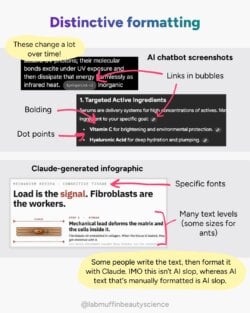
AI-generated science content is super prone to factual errors. Here’s how to spot it… Why spot AI slop?  Lots of typos and grammatical errors used to signal that something wasn’t checked carefully. Now, it’s AI slop signs. LLM-based chatbots (ChatGPT, Claude, Gemini) are prone to particular accuracy issues, and it’s unclear if these can be fixed People tend to believe …

Read more

Why you can’t trust AI chatbots for science

how LLMs work - dice analogy

Lazy AI-generated content is everywhere now. Unfortunately, AI chatbots like ChatGPT, Claude and Gemini aren’t reliable for factual content, especially science content. AI chatbots don’t “know things” AI chatbots don’t simply report information from a database, and they haven’t “learned all of human knowledge”. This is a common misconception that’s perpetuated by AI companies – when people think AI chatbots …

Read more

Why are skin cancer rates rising with more sunscreen?

melanoma mariam correlation

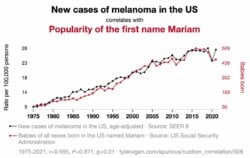
Sunscreen use is increasing, but skin cancer rates are also rising. Does that mean sunscreen doesn’t work, or – even worse – sunscreen might cause skin cancer? This was one of the common sunscreen myths I debunked in this video. Here’s one example, from @TonicHealth on TikTok: “Why is nobody talking about this? All these sunscreens are not doing the …

Read more

“Plastic-free” is the new clean beauty: a treatise

anti plastic clean beauty meme

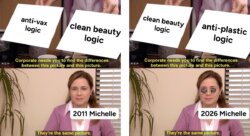
I recently came across a Threads post from @idea.soup that said: “I don’t have any evidence for it but I have a weird feeling the anti-polyester movement is about to become a right-wing pipeline” This was a lightbulb moment for me!  I started doing scicomm in 2011 because I realised the “non-toxic” clean beauty movement could be a pipeline to …

Read more

Is benzene in benzoyl peroxide a cancer risk?

fingertips benzoyl peroxide

There’s been a lot of stories about benzene contamination in personal care products over the last 4 years. This year, benzene was discovered in benzoyl peroxide, a staple acne treatment. How concerned should we be?  Petition and original paper I’ve written about the background behind Valisure’s benzene analyses before, as well as questions about the accuracy of their data and …

Read more

Red flags for unreliable sources: a guide

red flags for questionable sources

How do you check if information is reliable? One shortcut that works well (most of the time) is to check if the source itself is reliable! This is much faster and easier than trying to learn the science behind an area you’re not already familiar with – it takes a lot of time to properly factcheck information, even for experts. …

Read more

Benzene in your products, Part 2: The story of Valisure

Bunick confusion

Here’s Part 2 of our deep dive into benzene contamination in your products. In Part 1, we talked about whether the experiments were “realistic” (no), and whether the cancer risk was described accurately (also no). This time, we’ll be discussing the wider issues around the private lab behind these findings, Valisure. This is adapted from the video version (which works …

Read more

Does rosemary oil work for hair growth? The science

rosemary oil hair loss

Is rosemary oil a natural, science-backed treatment for hair growth?  According to a lot of doctors, scientists and trichologists across the internet, yes – there’s “scientific proof” that it works as well as minoxidil. But unfortunately, that isn’t true. It all seems to be a misunderstanding of a single study: Rosemary oil vs minoxidil 2% for the treatment of androgenetic …

Read more