I’ve talked about how Olaplex and other bond builders probably don’t act at broken disulfide bonds before – they do work to make hair feel and behave like it has more bonds, but they likely do this via other mechanisms, such as adding more hydrogen and ionic bonds.
But there’s an independent study titled “Bleached Hair as Standard Template to Insight the Performance of Commercial Hair Repair Products” that reported finding evidence for Olaplex working at broken disulfide bonds, like the original patent claims – what’s going on?
This study is a bit weird, and I don’t think their results support the mechanism in the Olaplex patent…
What the study found
The researchers bleached some hair samples, then 24 hours later, treated them with nothing, Olaplex or K18. They looked at the samples with a variety of analytical methods.
From the paper:
“the mechanism of action of Olaplex consists of creating new, non-specific, S-R bonds, as bis-aminopropyl diglycol dimaleate, the active ingredient of Olaplex, works as an acceptor molecule in a Michael addition reaction […] the fact that Olaplex promotes the formation of unspecific bonds (S-R) is in accordance with the fact that the signal is higher in Ellman’s test, but lower in the specific S-S Raman band.”
(Note: R in chemistry stands for a hydrocarbon chain, so an S-R bond means a sulfur-carbon bond.)
The two techniques used for this conclusion:
- Raman spectroscopy – Different bonds in hair scatter light at different wavelengths when you shine a laser on it. For example, S-S bonds scatter infrared at 425 to 550 cm-1.
- Ellman’s test – Ellman’s reagent (DTNB) reacts with SH (thiol) groups to produce a yellow substance. The more yellow it is, the more SH groups there are (the absorbance of the yellow solution at 412 nm is measured).
The researchers performed Ellman’s test on each hair sample (Condition 1, left in the diagram below), and after reacting each sample with a mixture containing sodium borohydride (NaBH4) – this reducing agent breaks some sulfur bonds to form SH (Condition 2, right).
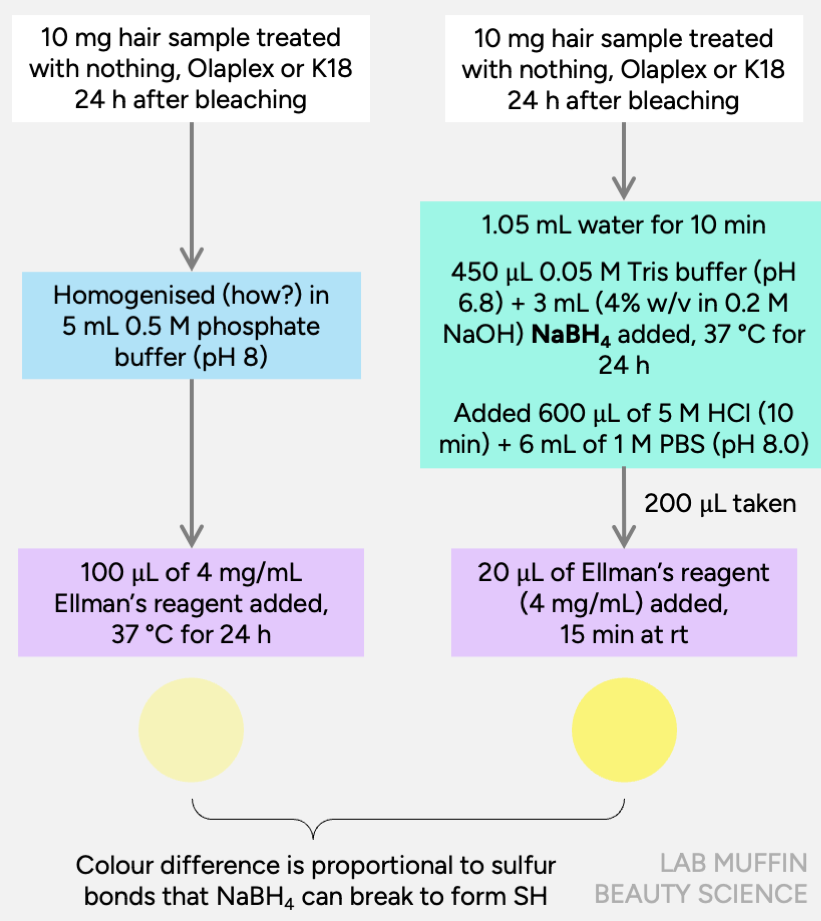
They subtracted the two values for each treatment to get the results in Figure 7B. Essentially, the Ellman’s test results show the sulfur bonds that could be broken by borohydride to form SH.
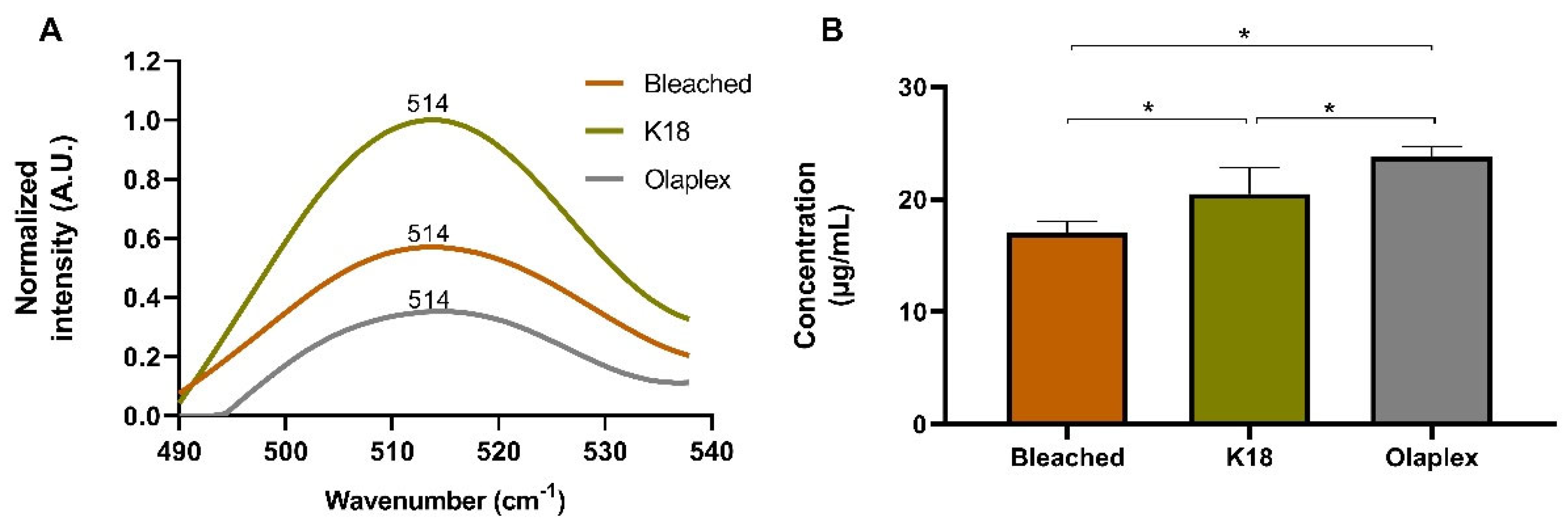
In other words, they’re saying that the new S-R bonds formed by Olaplex are measured in Ellman’s test but not the Raman spectrum, hence the larger gap between the two measurements for Olaplex means it formed more new S-R bonds.
Issues with the conclusion
The main issue: Ellman’s test can’t measure the new S-R bonds that Olaplex claims to form.
Olaplex doesn’t claim to form “non-specific bonds” – only the carbons on the double bond in Olaplex can react in a Michael reaction, so it’s a very specific S-R bond.
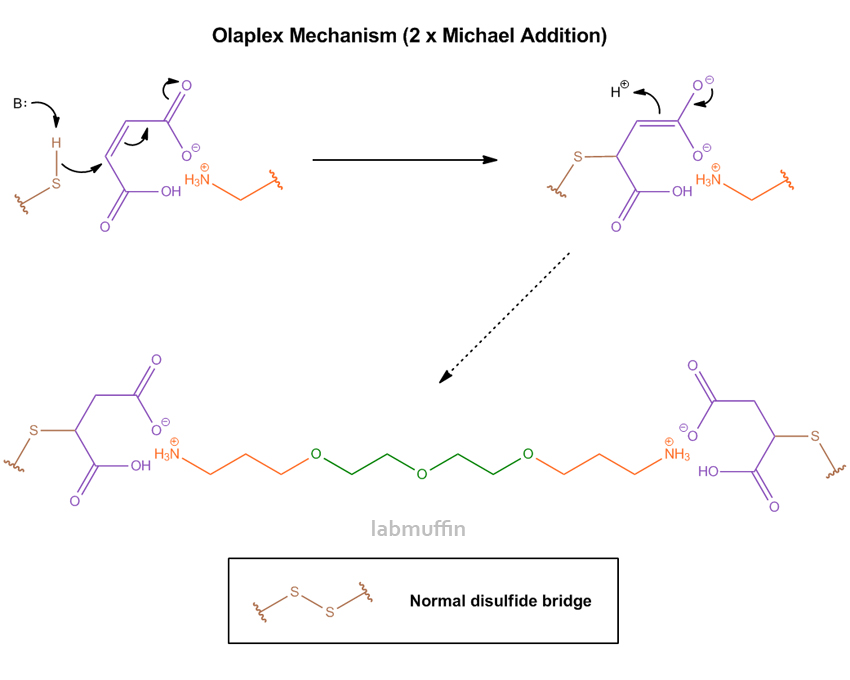
Sodium borohydride doesn’t break most sulfur bonds, and it definitely wouldn’t break the one that Olaplex claims to form.
Sulfur-carbon (S-R) bonds are almost always stable to borohydride, and are usually broken with transition metals or free radical reactions (this was part of my PhD work!). Borohydride mostly just breaks disulfide (S-S) bonds. I can’t think of any other bonds that Olaplex is likely to form that would show up in this Ellman assay.
The paper itself seems to be a bit unclear on what the Ellman test is measuring. The methods section says “Disulfide bond quantification was performed using Ellman’s assay procedure” (disulfide = S-S), but the results and discussion section says “S-R bonds were evaluated using Ellman’s chemical procedure”.
What’s going on?
If the Ellman test only measures S-S bonds and not the S-R bonds described by the Olaplex patent, why is there a difference in the results for the 3 treatments? I can think of a few possible explanations…
Hair structure opening up
Like other proteins, hair proteins are folded, so its natural S-S bonds can be buried quite deep. This means Ellman’s reagent won’t be able to reach them all unless you denature the hair properly first (i.e. get the proteins to unfold and expose more bonds).
Borohydride isn’t the only difference between the 2 Ellman conditions:
Condition 1:
- 10 mg hair sample homogenised in 5 mL of 0.5 M phosphate buffer (pH 8)
- 100 μL of 4 mg/mL Ellman’s reagent (in buffer) added, kept at 37 °C for 24 h in dark
- Absorbance at 412 nm measured
Condition 2:
- 10 mg hair sample hydrated in 1.05 mL deionised water for 10 min
- 450 μL of 0.05 M Tris buffer (pH 6.8) + 3 mL of 4% w/v NaBH4 (in 0.2 M NaOH) added, shaken at 37 °C for 24 h
- 600 μL of 5 M HCl added, shaken for 10 min
- 6 mL of 1 M phosphate buffer (pH 8) added
- 200 μL of the above sample taken, 20 μL of 4 mg/mL Ellman’s reagent (in buffer) added, shaken for 15 min at room temp
- Absorbance at 412 nm measured
Condition 1 seems to be quite gentle, while Condition 2 involves shaking in 0.2 M NaOH (pH ~13) for 24 hours – this is more alkaline than a standard depilatory cream. Hair’s structure quickly opens up at this pH. The homogenising method in Condition 1 isn’t described, but this usually refers to smashing hair into a powder – this should expose more S-S bonds, but given how high the bleach-only result is, I think quite a lot of S-S bonds were still inaccessible.
Bond builders block water
Both Olaplex and K18 seem to at least partly work by sitting in the hair and blocking water (and other aqueous solutions) from entering. Water loosens up hair’s structure, so the bond builders could decrease the accessibility of the S-S bonds more in Condition 1 for both Olaplex and K18, compared to the untreated bleached hair.
Related post: Hair, hydration and water: the real science
Olaplex No 0 was used, which has the Olaplex active at the highest commercially available concentration, mixed with water and preservatives only. The K18 formula used contains oily ingredients as well (e.g. cetearyl alcohol, dicaprylyl ether) – other analytical techniques used in the study suggested that it formed a lipophilic conditioning layer on the surface of the hair, which could also decrease hair wetting by the aqueous solutions used in Condition 1 (I would guess Condition 2 is extreme enough to blast past the bond builders and conditioners).
Experimental issues
If the Ellman procedure is reported accurately, there are a few issues that I think point to a less-than-robust methodology.
The two conditions use pretty wildly different concentrations of sample and Ellman’s reagent:
- Condition 1: 10 mg hair sample in a total volume of 5.1 mL, containing 100 μL of 4 mg/mL Ellman’s reagent
- Condition 2: 10 mg hair sample in a total volume of 12.21 mL, containing 1110 μL of 4 mg/mL Ellman’s reagent (amounts added are scaled up from the 200 μL to the equivalent amounts for the whole original 10 mg in 11.1 mL)
This means directly subtracting the two colorimetric measurements won’t give a meaningful number – essentially, they’re in different units (in the original assay, the concentrations are equal).
It also seems a bit strange to me that 200 μL was taken out, especially for Condition 2 but not Condition 1. In other studies where this assay was used for hair, Ellman’s reagent was added to the whole sample for both conditions, which would better allow for reaction with all of the 10 mg of hair (one of the studies even uses a chaotropic agent and extracts the keratin before reaction). I’d expect that the mixtures wouldn’t be homogenous (little solid bits of hair might float or settle out), so the 200 μL sample taken out may not be an accurate reflection of the whole mixture.
The concentrations of SH measured are in the same ball park as the Ellman’s reagent concentrations (~18-24 ug/mL of cysteine = 0.15-0.20 mM, Condition 1 = 0.20 mM, Condition 2 = 0.92 mM), which suggests that the Ellman’s reagent might not be in excess for these measurements (although I think the issues above are probably more significant). It’s also possible that like the coconut oil/water blocking studies, the weight of the applied product could mean there’s less hair in some of the 10 mg samples – in the study, 10% w/w of both Olaplex and K18 were applied without rinsing afterwards, but I don’t think this would make a huge difference given how much water is in both products.
Related post: Does water damage hair? The myth of “hygral fatigue”
K18 findings
I’m a bit less sure of what the paper is claiming for K18’s mechanism. It says:
“The analysis of Ellman’s test, on the other hand, revealed that K18 treatment led to the formation of new covalent bonds between the sulfur group of cysteines in keratin and other thiol groups, but this was not observed in Raman spectra (Figure 7A). Ellman’s test indicated, however, that Olaplex induced a significantly higher S-R bond establishment than K18 (Figure 7B) […] K18 is claimed to regenerate and form new disulfide bonds”.
But disulfide (S-S) bonds between K18 and K18, K18 and hair keratin, and hair keratin and hair keratin would all give the same result in the Ellman test, so it isn’t telling us much there either.
Another conclusion is that Olaplex works at a deeper level than K18, but this seems to be mostly based on the SEM and AFM results – these microscopic techniques probe what the surface looks like. e.g.
“While K18 is reported by the commercializing brand to establish new disulfide bonds, Olaplex showed a superior positive effect in the establishment of overall S-R bonds compared to the Bleached hair. These outcomes suggest that deeper bonds exist in Olaplex than in the K18 product, also corroborated by SEM and AFM analysis, which indicates that penetration of Olaplex across the fiber surface may be occurring.”
“SEM and AFM observations showed that K18 acts at a superficial level without a significant effect on the core of the hair fiber”
This interpretation seems to rely on the assumption that a formula can only work in one part of the hair (i.e. if it’s leaving a conditioning layer on the surface, it can’t be absorbing deeper). This isn’t true – for example, semi-permanent hair dyes contain conditioning ingredients which form a surface layer, and dyes which are absorbed more deeply. If they used one of the conditioning formulas from Olaplex (e.g. No 3 or No 6) instead of the minimalist No 0, the SEM and AFM results would probably look a lot more similar for the two products.
Other thoughts
Based on their other publications, the authors seem to specialise in biotech and instrumental analysis techniques, so it isn’t too surprising that the organosulfur mechanism and chemical assay parts might have some issues. I’d guess that they realised the Raman spectroscopy and Ellman’s test results didn’t quite make sense together, and they put too much trust in the Olaplex patent’s explanation (like me – it was published by respected chemistry academics) to try to come up with a possible explanation, but didn’t have access to a chemist with organic/organosulfur knowledge, or a hair scientist to run it past.
I think this is a good reminder of a few annoying things about cosmetic science, which I’ve discussed before:
Peer review doesn’t mean “reliable” or “established science”. This is true for all of science – peer review just means that an editor and a couple of peer reviewers checked the paper and thought it looked OK. The real test for science is post-publication review. This is when studies are put into context, and findings from different studies are judged scientifically to work out what the overall body of evidence shows.
Related post: Why “peer reviewed” studies aren’t reliable (especially for beauty science)
Independent cosmetic science research isn’t automatically better – in fact, I’d say it’s generally lower quality. There’s little public funding for cosmetic research, since it’s harder to justify for public interest compared to curing cancer, renewable energy etc. This means:
- Most cosmetic science is done outside of traditional academia, so only a small fraction of the research is published in standard academic peer-reviewed journals – academic scientists won’t be able to find a lot of it with a standard literature search (organic chemistry is also tricky, especially without database subscriptions)
- Independent researchers don’t have as much relevant expertise
- There are also less peer reviewers with relevant expertise, so you need to proceed with caution with the vast majority of peer-reviewed articles – we were told in a TRI Princeton hair science course that pretty much the only peer-reviewed journal you could largely rely on was the International Journal of Cosmetic Science (this paper was also published by MDPI, which doesn’t have a great reputation for rigorous peer review, so you kind of have to do the peer review yourself)
- Research funded by industry is almost always higher quality (better access to instruments, better understanding of appropriate methodologies etc.).
Related post: Is Retinol a Scam? The Science
With industry-funded research, there’s obviously the financial conflict of interest that needs to be considered, so you can’t blindly trust that either. You should really critically appraise all cosmetic science research, keeping in mind the context, perspective, and motives involved (not just financial – essentially, apply some source analysis techniques used by historians).
(This also isn’t entirely unique to cosmetic science, just more complex to navigate – for example, most drug and vaccine research is heavily industry-funded, but a lot more scientists who participate in traditional academic publishing are trained to design and evaluate the studies, there’s more public funding for higher quality independent studies, there’s far more incentive to publish etc., so it’s easier to evaluate with the publicly available literature.)
References
Pressly ED, Hawker CJ. Methods for fixing hair and skin. US20150034117A1. Published online February 5, 2015.
Martins E, Castro P, Ribeiro AB, et al. Bleached Hair as Standard Template to Insight the Performance of Commercial Hair Repair Products. Cosmetics. 2024;11(5). doi:10.3390/cosmetics11050150
Cornwell P, Marsh J. How Bond Builders ‘Repair’ Hair. Cosmetics & Toiletries. February 27, 2023.
Cornwell P, Cranwell P. Bond Builders: Top Tips for Product Development & Must-Knows for Claim Support. TRI Princeton. November 24, 2024.
Gourion-Arsiquaud S, Cranwell P. An introduction to IR and Raman spectroscopy: harnessing the power of light in molecular analysis. TRI Princeton. February 29, 2024.
Luo Y, Matejic T, Ng CK, et al. Characterization and Analysis of Biopharmaceutical Proteins. In: Separation Science and Technology. Vol 10. Elsevier; 2011:283-359. doi:10.1016/B978-0-12-375680-0.00008-5
Hansen RE, Østergaard H, Nørgaard P, Winther JR. Quantification of protein thiols and dithiols in the picomolar range using sodium borohydride and 4,4′-dithiodipyridine. Anal Biochem. 2007;363(1):77-82. doi:10.1016/j.ab.2007.01.002
Cruz CF, Azoia NG, Matamá T, Cavaco-Paulo A. Peptide—protein interactions within human hair keratins. Int J Biol Macromol. 2017;101:805-814. doi:10.1016/j.ijbiomac.2017.03.052
Fernandes M, Cavaco-Paulo A. Protein disulphide isomerase-mediated grafting of cysteine-containing peptides onto over-bleached hair. Biocatal Biotransform. 2012;30(1):10-19. doi:10.3109/10242422.2012.644436
Oae S. Organic Sulfur Chemistry: Structure and Mechanism. CRC Press 2018. doi:10.1201/9781351075275