AI-generated science content is super prone to factual errors. Here’s how to spot it…
Why spot AI slop?
Lots of typos and grammatical errors used to signal that something wasn’t checked carefully. Now, it’s AI slop signs.
- LLM-based chatbots (ChatGPT, Claude, Gemini) are prone to particular accuracy issues, and it’s unclear if these can be fixed
- People tend to believe they’re more accurate than they are (this is by design – it generates more profits for AI companies)
- They can make convincing-looking arguments for any position
- AI text is extra hard to factcheck and override thanks to cognitive biases like the fluency heuristic (text that reads smoothly feels more truthful to us)
It’s much easier to write in your own style than to get the facts right, so info with a lot of AI slop signs is likely to be unverified – you should probably verify it yourself.
Related post: Why you can’t trust AI chatbots for science
How NOT to spot AI slop
Formal tone, good grammar and punctuation, a few “tells” with other reasonable explanations and AI detectors aren’t very reliable for detecting AI use. All “AI signs” need to be considered in context – most are found in human-made content too!
The key is to spot so many signs that it’s very unlikely to be coincidence.
In general, I don’t think public callouts are all that productive:
- People usually just hide their use better. AI chatbots foster dependence, and posting AI slop is beneficial short-term.
- Incorrect callouts may encourage AI use (“if no one can tell the difference, I might as well use a shortcut”), and most of us aren’t as good at detecting it as we think
- There are social inequities with who gets punished more harshly in the court of public opinion (women of colour, especially Black women, surprise surprise)…
- … and with who does more harm with AI use. In my experience, it’s mostly men who use AI slop to pose as experts and spread pseudoscience.
It’s usually safer to just unfollow, and roast them in your group chats 😉
Specific “tells”
AI text has linguistic quirks that frequently show up, due to inherent biases in how they work. For example:
- Em dashes and semicolons
- “It’s not ___, it’s ____” and variations (negative parallelisms)
- “Here’s the [twist]:”
- “No ____. No ____.”
- “And honestly”
- “Quietly”
- “The signal”
- “____ matters.”
- Bullet points and emojis
- Lists with 3 things
These tells change with the LLM model used, but historical signs are still useful. If older AI slop posts are still live, the person likely doesn’t know about the accuracy issues with AI chatbots, or don’t care, so they’re unlikely to have changed their processes.
Humans use these too in their writing, so again, seeing a few of these isn’t a good indicator of AI slop. But overuse – especially when it doesn’t make sense, or it’s out of character for the author – is a red flag.
Distinctive AI chatbot formatting
Some people use screenshots of AI chatbots, or typical AI-generated infographic styles – Claude is very popular for generating science infographics at the moment.
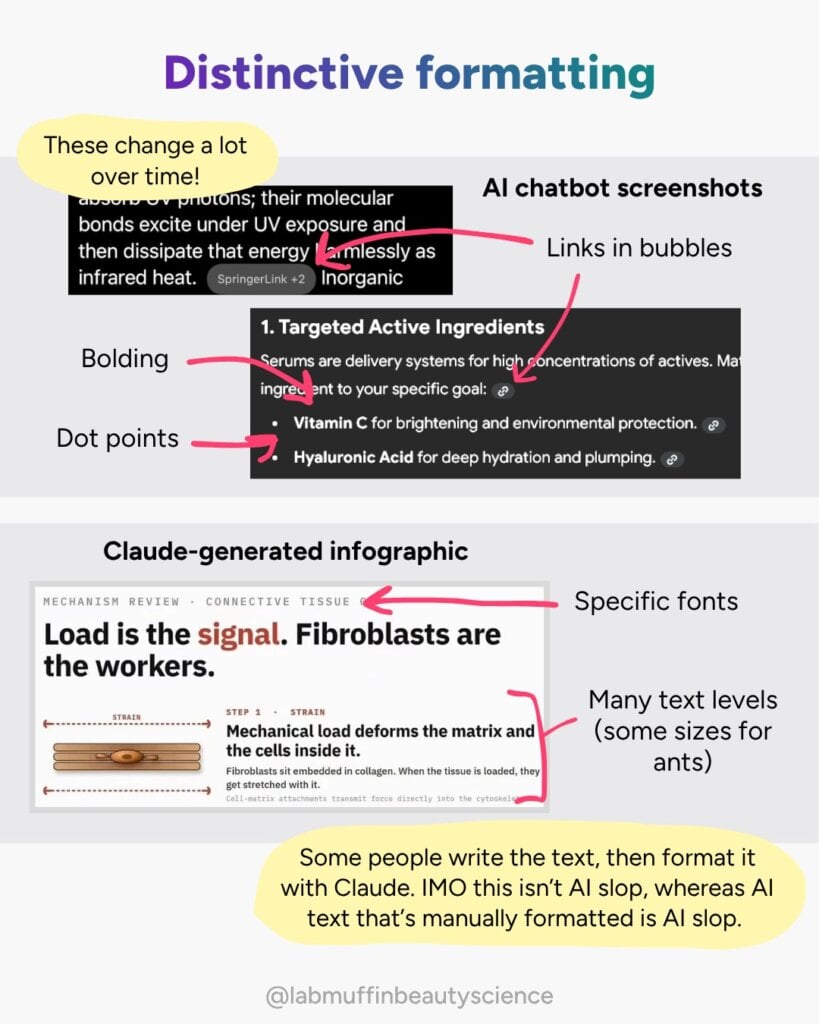
Note: Some people write the text, then format it with Claude. In my opinion this isn’t AI slop, whereas AI-generated text that’s manually formatted (also very common) would be AI slop.
Overall writing “voice”
Every human writer has a particular “voice”, or personality – so do AI chatbots. This is easier to spot if you’ve knowingly read a lot of AI text. The main signs in AI-generated science content:
Everything is super important and meaningful
- Everything gets a label
- “The gap”
- “The missing piece”
- Short sentences and rhetorical questions for dramatic effect
- Basic facts are framed as deep insights:
- “But here’s the ____:”
- “____ was never the ____”
- Vague lofty generalisations that sound like universal truths:
- “Scientists say”
- “A German study”
- It sounds a bit like an inspirational LinkedIn post – think “Here’s what stepping in dog poop taught me about B2B sales”
Wordy, not information-dense
- Restates the same idea multiple times, with little change in meaning (that email could’ve been a sentence)
- Avoids simple words
- Avoids reusing phrases (except for dramatic effect)
Note: These signs are for science content – AI voice is different for different contexts e.g. fiction. But one big sign is that many writers sound like they could be the same averaged-out generic person.
Chatbot convo remnants
AI slop-posters are generally lazy (this is partly due to how AI chatbots are designed to foster dependence), so posters sometimes paste in text from the chatbot response, like quotation marks, or signposts like “Here’s a clean Instagram caption:” “Post 1”.
Some of these could come from an email, or could just be a typo – you’d want to see other slop signs to be sure.
Hyperprolific output (high volume of posts)
It’s very quick and low-effort to generate AI slop, but accurate factual content takes a long time to make – it can take a few hours to read just one scientific paper properly! Scientific expertise is narrow, so it takes even longer if you’re new to a topic.
AI slop-posters tend to post longer posts, more often, on a wide range of topics, with great confidence.
(This is also a red flag for academic fraud – for example, the rosemary oil study author published 369+ papers in 2024.)
Sudden recent changes
Look for inconsistencies between old and new content, or from post to post. Free ChatGPT launched late 2022, but AI slop really got going in 2025.
Examples:
- Surge in dramatic clipped sentences
- Sudden increase in em dashes, semi-colons, Oxford commas, bullet points, emojis
- Sudden recent increase in posts
- Uncharacteristically perfect spelling, grammar and punctuation
- Length of captions has drastically increased, with lots of fluff
Undiscerning attitude towards AI
This indicates that they may not know the downsides and limitations of AI chatbots, or might not care.
- Using AI chatbots for other tasks they’re bad at
- Assuming “everyone uses AI”
- Overreliance – “I use AI for everything”
- Emotional dependence – “I love AI!”
- Participating in AI data-harvesting trends
Note: someone saying that they “hate AI” isn’t good evidence that they don’t use it – lots of people have been caught using AI after denying it.
Inhuman errors
AI chatbots often make mistakes that humans are unlikely to make. These can be hard to spot if you don’t know the topic, but are often obvious if you check the original source.
- Fake quotes
- Fake references (largely fixed now for science)
- Speaking in great detail about a topic, but messing up really basic facts
- Posting contradictory things e.g. disagreeing with their own post in the comments, text that disagrees with the diagram it’s next to
- Words and phrases that don’t make sense (“tortured phrases”)
Inhuman choices
AI chatbots are not good at organising ideas – they’re great at pattern-matching, but not judgement. Look for AI tells that don’t make sense, and don’t seem like human decisions.
- “It’s not __, it’s ___” for something that isn’t a common misconception
- Tone is far too profound for the context
- Things in a list that aren’t in the same category
- Full sentences in tables and titles
- Weird splitting of concepts
MUDCAPS
This is a list of red flags for unreliable experts. The lack of concern about accuracy and ethics that underpins these also lead to AI slop-posting, in particular:
- Misleading credentials – many AI slop-posters are trying to fake expertise they don’t have
- Not crediting others – AI generated content is really just plagiarism scaled up
- Overly relying on your authority to make up for not knowing the topic well
Humans posted misinformation carelessly before AI chatbots. Posting AI slop is another red flag for an unreliable “expert” whose information you should double check before trusting.
Exercise
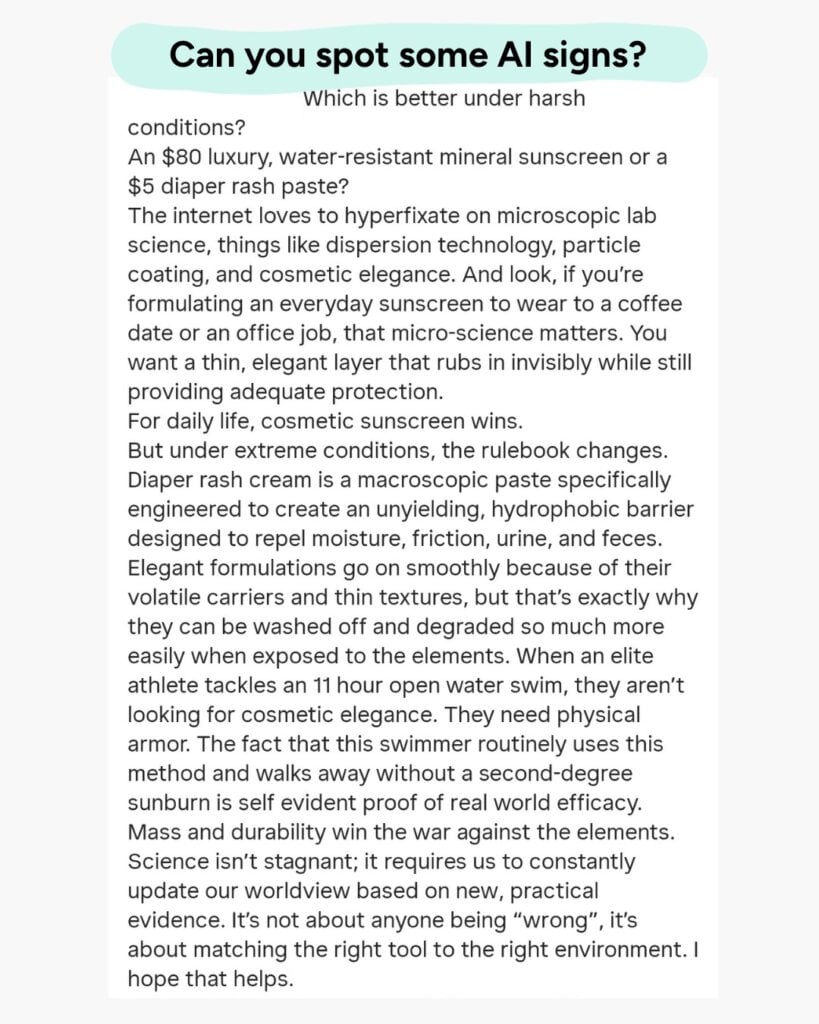
Here’s a passage with a lot of AI slop signs – how many can you spot?
This article was adapted from my video on AI slop from science communicators. An infographic version can be found on Instagram or YouTube.