Lazy AI-generated content is everywhere now. Unfortunately, AI chatbots like ChatGPT, Claude and Gemini aren’t reliable for factual content, especially science content.
AI chatbots don’t “know things”
AI chatbots don’t simply report information from a database, and they haven’t “learned all of human knowledge”. This is a common misconception that’s perpetuated by AI companies – when people think AI chatbots are kind of magic, they tend to use and trust them more.
AI chatbots like ChatGPT, Claude and Gemini are based on large language models (LLMs). Fundamentally, these put words that are usually near each other, near each other, without really understanding what the words actually mean.
An analogy: they basically have a huge set of loaded (uneven) dice for outputting text. The dice are chosen based on the prompt, and the previous words (not just the previous word – this is partly why modern chatbots are much more powerful than older ones).
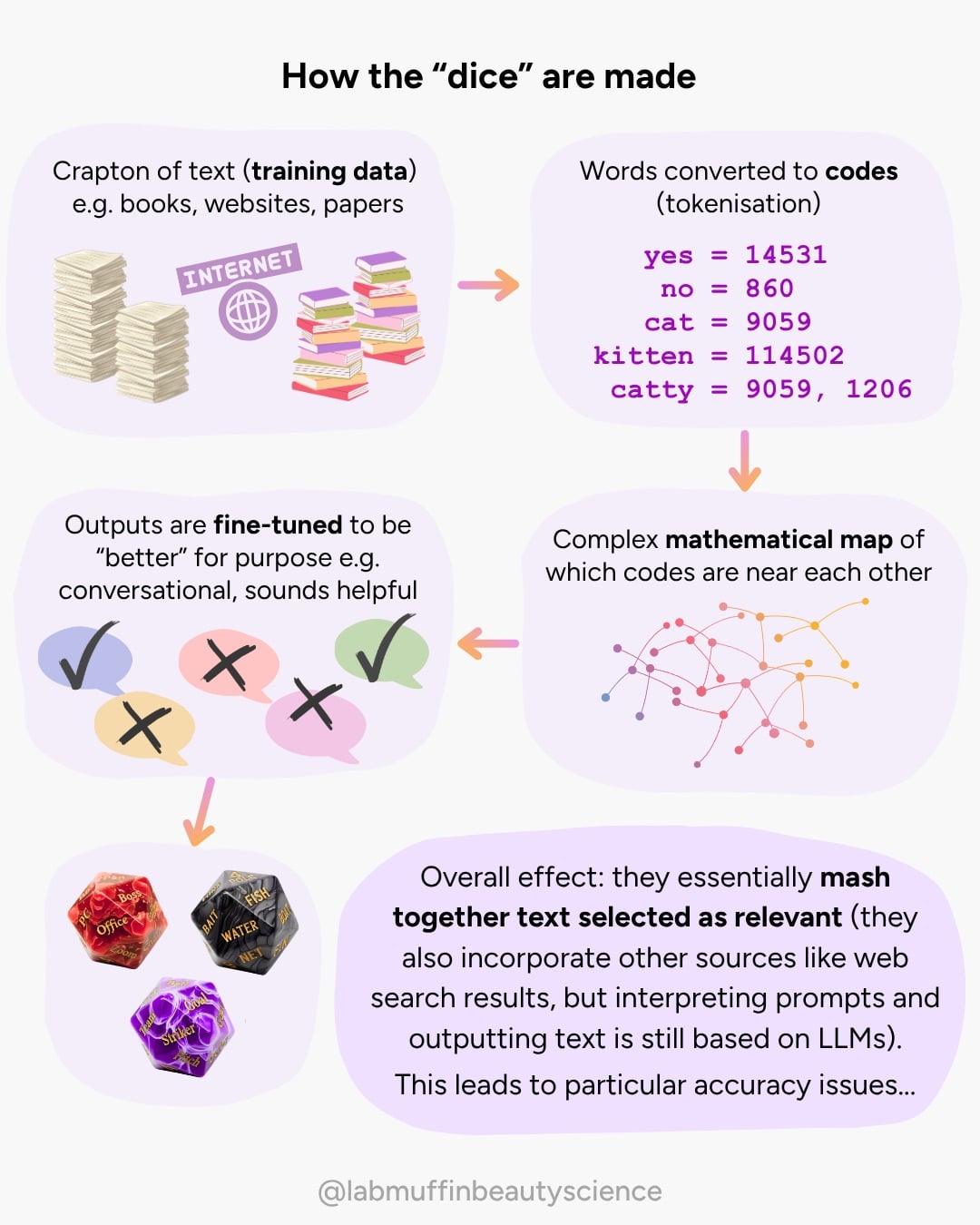
How the “dice” are made (this is very simplified):
- Training data (a crapton of text such as books, websites and papers) are converted to codes (tokenisation)
- This is used to create a complex mathematical map of how the codes are found in relation to each other in the training data – this is used to interpret prompts and output responses
- Outputs are fine-tuned for a particular purpose e.g. more conversation, sounding helpful (for example, responses can be scored by a human, then the model analyses the scores to output higher scoring responses)
The overall effect is that the LLM essentially mashes together text that’s selected as relevant. Other sources like web search results can be incorporated, but the LLM architecture is still used to interpret prompts and output text responses.
This leads to particular accuracy issues…
AI chatbots rely on correlation
LLM-based outputs appear sensible and human-like because language correlates with concepts, but they aren’t the same (this is essentially correlation isn’t the same as causation).
- Humans don’t solely learn from information captured in text.
- Words are converted to codes during the tokenisation process, so meaning needs to be derived from the relative positions of codes in the training data.
Essentially, AI chatbots are always BS-ing – they output text without reference to reality.
Chatbot outputs often correlate with reality, so they can be useful. Mashing examples of text together works surprisingly well for some tasks! But it also doesn’t work well for many tasks that are simple for humans to do.
Note: This is why you can’t “ask AI to do something” without verifying it. It’s more likely to mash together examples of text where that task was done, than to actually do it.
They’re especially bad for science
The accuracy of AI chatbots depends on the accuracy and quantity of inputs (training data text, search results).
- For many scientific topics, there simply aren’t enough accurate examples available
- AI chatbots tend to summarise what’s most prevalent online, so they often repeat common myths
- Scientific language is precise, so an LLM unthinkingly rewording text (which usually relies on the original large training data set that isn’t subject-specific) can change the meaning of the text a lot.
- Outputs can be very sensitive to how prompts are worded, and will often cherrypick sources to confirm your premise
- AI chatbots don’t have access to paywalled sources – even “deep research” features tend to use open access sources that skew towards lower quality e.g. marketing websites, abstracts and introductions, predatory journals
- Many peer-reviewed sources contain errors that need subject-specific expertise to spot, e.g. studies have found ~25% of citations don’t back up the claim, even in higher quality journals (this is on top of all the dodgy preliminary studies and fraud…)
There are many examples of AI summaries of studies that are woefully incorrect – for example, a study I coauthored was described as research from “a Harvard team”, even though only 1 out of 4 authors are from Harvard.
AI chatbots may not get better
It’s currently unclear whether techniques that (in theory) should increase accuracy, actually do. This includes:
- using “reasoning” approaches e.g. chain of thought (CoT)
- fine-tuning by experts
- weighting selected data more heavily e.g. retrieval-augmented generation (RAG), where you can upload specific documents for them to use (they still have to rely on the original large corpus to interpret the prompt and output a fluent response – models trained on smaller amounts of text cannot give sensible outputs)
These can give more convincing illusions of thinking – seemingly logical reasoning for an answer that wasn’t determined by logic, but from standard LLM-based pattern-matching.
- CoT models will change their answer based on words added to the prompt, without mentioning it in their new “reasoning”
- AI chatbots are bad at basic coding problems in esoteric languages with less GitHub examples, even when all required logic is provided
- Specialised clinical AI tools were recently found to be worse on medical benchmarks than general chatbots – they performed similarly to Google Search AI Overview on real clinical queries
Bottom line: You need to know the “real answer” (and whether there even is a real answer) to know if AI-generated text is accurate or not.
AI text is extra hard to factcheck
If you know the topic, then in theory, you could just check the AI chatbot’s output. But that’s where our cognitive biases kick in…
Fluency heuristic: Fluent, easy-to-process text feels more truthful to us
Confidence effect: We tend to see sources that sound more confident as more credible
Confirmation bias: AI chatbots tend to give us the answers we want
Automation bias: We tend to trust decisions made by machines
Authority bias: People who don’t understand how AI chatbots work believe they’re authoritative
These mental shortcuts require a lot of effort to override – you need to fight against thousands of years of human evolution. It’s extremely easy to just nod along and agree.
AI text is a bad starting point
On top of being inaccurate and extra hard to factcheck, there are other reasons why AI-generated text is one of the worst starting points for factual content, largely as a result of the way LLMs work:
Anchoring effect: It’s hard for us to override how the starting point frames things
Verbose: LLMs tend to add a lot of unnecessary fluff and repeat the same information multiple times, so it takes longer to read and check
Bad at organising concepts: If you’ve read an AI summary of a meeting or an email, you’ll know it groups things weirdly
Jagged intelligence: Mashing text together only works for some tasks, so LLMs make weird inhuman mistakes we’re not used to looking for
Compounded biases: LLMs output common patterns from its sources, including racial, gender etc. biases – this is getting worse as LLMs are trained on more LLM outputs (model collapse)
AI slop is a bad sign
Anecdotally, I’ve struggled to find creators posting science content with obvious AI slop signs who aren’t also making factual mistakes. Writing in your own style is usually far easier than getting the facts right, and factchecking AI text is very difficult with all these cognitive biases at play.
That’s why spotting AI slop is a red flag for inaccurate science content, and it’s more complex than just seeing an em dash! Stay tuned…
This article was adapted from my video on AI slop from science communicators. An infographic version can be found on Instagram or YouTube.
References
Tully SM, Longoni C, Appel G. Lower Artificial Intelligence Literacy Predicts Greater AI Receptivity. J Marketing. 2025;89(5):1-20.
George D Montanez. LLMs, Model Collapse, and the Conservation of Information (lecture, on YouTube as “Model Collapse Ends AI Hype”).
On Bullshit, Hallucinations, and AI. Jordan Harrod, es machina (Substack). February 26, 2025.
No, “AI” is not a Stochastic Parrot 🦜. Margaret Mitchell. Medium. March 5, 2026.
The architecture behind web search in AI chatbots. Ida Silfverskiöld, Towards Data Science. December 4, 2025.
Baethge C, Jergas H. Systematic review and meta-analysis of quotation inaccuracy in medicine. Res Integr Peer Rev. 2025;10(1):13.
Smith N, Cumberledge A. Quotation errors in general science journals. Proc. R. Soc. A 2020;476(2242):20200538.
Chen Y et al. (Anthropic Alignment Science Team). Reasoning models don’t always say what they think. May 8, 2025. arXiv:2505.05410.
Sharma A, Chopra P. EsoLang-Bench: Evaluating Genuine Reasoning in Large Language Models via Esoteric Programming Languages. May 11, 2026. arXiv:2603.09678
Vishwanath K, Alyakin A, Ghosh M, et al. General-purpose large language models outperform specialized clinical AI tools on medical benchmarks. Nat Med. 2026;32(7):2405-2409. doi:10.1038/s41591-026-04431-5